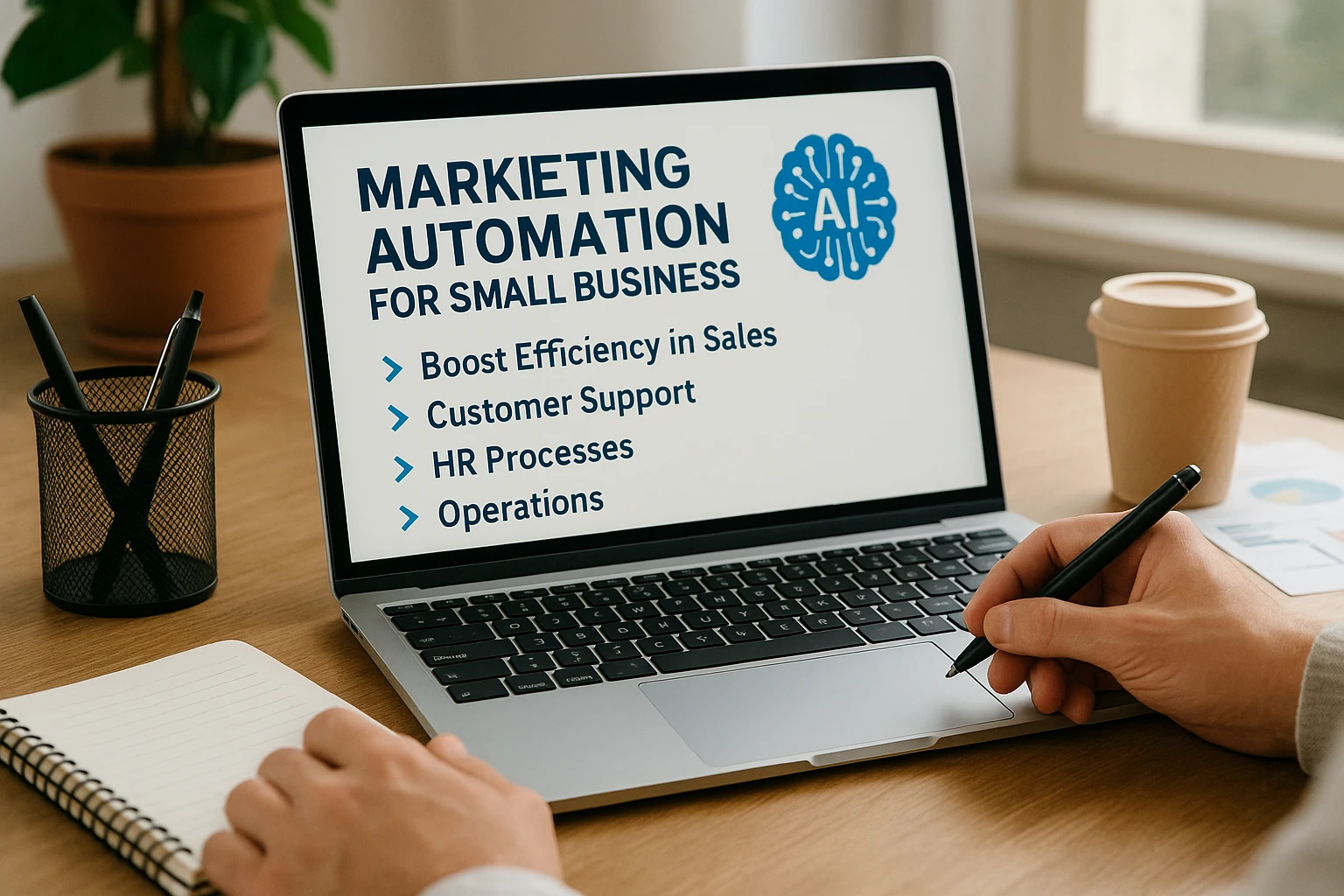
Marketing automation for small business uses AI-driven tools to streamline repetitive tasks like email campaigns, lead nurturing, and audience segmentation. This allows small companies to save significant time and compete effectively with larger organizations by focusing their limited resources on growth and strategy rather than manual execution.
AI applications extend well beyond marketing into sales, customer support, HR, and operations. Across all of these departments, small businesses can save time, reduce costs, and improve experiences for both customers and employees. Learn more about AI automation benefits for small businesses.
This post explores how AI can transform each major department. We start with marketing automation for small business, then cover AI in sales, customer support, HR processes, and operations. The goal is to provide actionable insights that help small businesses run more smoothly and scale faster.
See also: AI marketing automation resources and HubSpot's beginner's guide to marketing automation.
Marketing Automation for Small Business
Marketing automation for small business enables owners to run sophisticated, data-driven campaigns with minimal manual effort. AI handles tasks like email sends, social media scheduling, and audience analysis, allowing small teams to deliver personalized content at scale without requiring large marketing departments or expensive agencies.
Think of it as having a dedicated marketing assistant that nurtures leads, tracks campaign performance, and optimizes your outreach automatically. Small businesses gain the kind of marketing capabilities that were previously available only to large enterprises with dedicated teams. Key tools that make this possible include the top AI tools for small businesses:
- Email Automation: Tools like Keap or Mailchimp send welcome emails, follow-up sequences, and promotional campaigns on autopilot. This scales your outreach consistently without requiring someone to manually send each message.
- Lead Management: AI captures leads from your website or ads, groups them by interests and behavior, and scores them by purchase likelihood. Sales teams can then prioritize the most promising prospects.
- Personalized Content: AI analyzes customer actions, including what they click, browse, and buy, then segments audiences and crafts targeted messages for each group. This personalization dramatically increases engagement and conversion rates.
- Chatbots and AI Assistants: These tools answer common questions instantly, collect lead information, and provide support around the clock. They convert website visitors into customers faster by ensuring no inquiry goes unanswered.
The benefits are substantial and well-documented. Full breakdown of AI automation benefits. Time savings are often the most immediately noticeable improvement, as automation eliminates hours of repetitive daily tasks and frees teams to focus on creative strategy and relationship building.
ROI improves significantly as well. Personalized campaigns boost conversion rates and customer retention, with some small businesses reporting revenue increases of up to 800% from well-implemented automation. Affordability makes this accessible to nearly any budget, as many platforms offer low-cost plans with intuitive setup processes that require no technical expertise.
To get started, pick one focused area like email marketing automation. Choose a tool with built-in AI capabilities and ready-made templates, set up trigger rules (such as sending a welcome sequence after a new sign-up), monitor your results, and refine your approach based on the data. Marketing automation naturally feeds qualified leads to your sales team, which brings us to the next department.
More reading: Marketing automation strategies for small businesses and nine marketing automation benefits.
AI in Sales for SMB
Marketing and sales are closely connected. Leads generated through marketing automation flow directly into your sales pipeline, and AI in sales automates the scoring, prediction, and follow-up processes that help small businesses close more deals without hiring additional staff.
Key applications include the following (best automation tools for SMB sales):
- AI Lead Scoring: This ranks leads by their likelihood to convert, analyzing signals like past purchases, website behavior, and engagement patterns. Sales reps can focus their energy on the hottest prospects rather than chasing cold leads.
- Predictive Analytics: AI reviews historical sales data to forecast which deals are most likely to close and when. This improves pipeline management and helps teams allocate their time where it matters most.
- Automated Follow-Ups: Systems send timed emails and reminders based on prospect behavior. If a lead goes quiet, AI re-engages them with personalized outreach, keeping deals moving through the pipeline and improving close rates.
Consider a practical example: a small service company integrated AI into their CRM to automate nurture sequences for cold leads. Reminders and follow-up emails went out automatically based on prospect behavior, and conversion rates rose by 30% with no additional hires needed.
The benefits extend across the entire sales operation. Cost-cutting benefits of AI automation include better targeting, higher conversion rates, and seamless collaboration between sales and marketing. AI also improves revenue forecasting accuracy, which supports better budgeting and growth planning.
For setup, integrate AI capabilities with your existing CRM (such as Salesforce or HubSpot). Start small by automating follow-ups first, then train the AI with your historical data to improve its accuracy over time. Happy sales outcomes naturally lead to satisfied customers, which brings us to the role of AI in customer support.
AI for Customer Support Teams
AI for customer support teams transforms how small businesses handle customer inquiries. It speeds up response times, raises satisfaction scores, and reduces costs, all critical factors for SMBs with limited support staff who need to deliver excellent service consistently.
The primary tools in this area include (AI tools for customer support teams):
- Chatbots: These handle common questions around the clock, such as order status inquiries and basic troubleshooting. They free human agents to focus on complex problems while dramatically reducing wait times for customers.
- Sentiment Analysis: AI reads incoming messages for emotional tone and urgency. If a customer sounds frustrated or upset, the system flags the interaction for immediate human attention, preventing small issues from escalating.
- Automated Ticketing Systems: Support requests are logged, categorized, and routed to the appropriate team member automatically. This eliminates lost emails, slow routing, and inconsistent prioritization.
The impact on SMBs is significant. Efficiency benefits of AI include faster resolution times, consistent handling across all interactions, and the ability to scale support volume without proportional headcount increases. Businesses using AI chatbots report response time reductions of up to 80% alongside measurable improvements in customer satisfaction scores.
For implementation, start by selecting a chatbot platform that fits your website or app. Load it with answers to your most frequently asked questions, build a knowledge base from real customer queries, and review conversation logs weekly to improve accuracy. Connecting your support tools to sales data provides valuable context (like purchase history) that enables more helpful, personalized responses.
Automate HR Processes
Automating HR processes with AI cuts paperwork and accelerates administrative tasks that consume disproportionate time in small businesses. The result is better hiring, smoother onboarding, and more effective people management without requiring a large HR department.
Key applications include (HR automation tools for small business):
- Resume Screening: AI scans applications for relevant keywords, skills, and experience, then ranks candidates by fit. This saves hours of manual resume review and helps surface qualified candidates faster.
- Onboarding Automation: New employees receive automated email sequences with checklists, training materials, and paperwork, all personalized based on their role. This creates a consistent, professional first impression.
- Performance Tracking: AI monitors productivity metrics, flags upcoming review dates, and sends feedback prompts to managers. This keeps performance management on track without constant manual oversight.
The benefits are direct and measurable. How AI cuts HR costs. Administrative burden drops significantly as form-chasing and manual scheduling are eliminated, freeing HR staff for strategic work. Talent acquisition improves through data-driven candidate evaluation, and retention rates rise with fair, consistent performance tracking. Compliance also becomes easier, as AI tracks deadlines, manages documentation, and sends reminders for regulatory requirements.
Small businesses often struggle with HR due to limited resources, and automation levels the playing field considerably. For example, one startup automated its resume screening process and cut time-to-hire by 50%, allowing the team to focus on growth instead of administrative overhead.
To get started, consider tools like BambooHR or Workable that include AI features. Begin with onboarding workflows, integrate with your payroll system for seamless data flow, and review reports monthly to refine your processes.
AI Automation in Operations
AI automation in operations streamlines the daily workflows that keep a business running, targeting supply chain management, inventory control, and equipment maintenance. Small businesses gain both cost savings and operational reliability from these improvements.
Key areas include (operations automation tools):
- Supply Chain Optimization: AI forecasts demand based on sales data, seasonal patterns, and market conditions. It identifies potential delays and recommends ordering adjustments, preventing both shortages and costly overstock situations.
- Inventory Management: Automated tools track stock levels in real time and trigger reorders when inventory drops below set thresholds. This reduces waste, lowers storage costs, and ensures products are available when customers need them.
- Predictive Maintenance: Sensors combined with AI monitoring predict equipment failures before they happen and schedule maintenance proactively. This approach can reduce unplanned downtime by up to 50%.
For implementation, choose cloud-based software with built-in AI capabilities for minimal setup complexity. Connect your operations tools to sales and finance systems for a complete view of your business. Set up alerts for low stock levels or equipment wear indicators, and use dashboards to monitor performance and adjust thresholds based on results.
Across all operational areas, AI drives measurable efficiency improvements. Small businesses consistently see lower costs and higher output when they apply automation thoughtfully. See efficiency gains in action.
Marketing automation for small business is often the natural starting point for an AI journey, and the benefits compound as you expand into sales, customer support, HR, and operations. The common thread across all departments is the same: save time on routine work, reduce costs with intelligent tools, and improve experiences for customers and staff alike.
Start with marketing for fast, visible wins, then assess each department for automation opportunities. Pick tools that are easy to implement and integrate with your existing systems, and expand from there. With the right approach, any small business can leverage AI to operate with the efficiency and sophistication of much larger organizations.
More resources: AI marketing automation resources and AI marketing automation guide.