
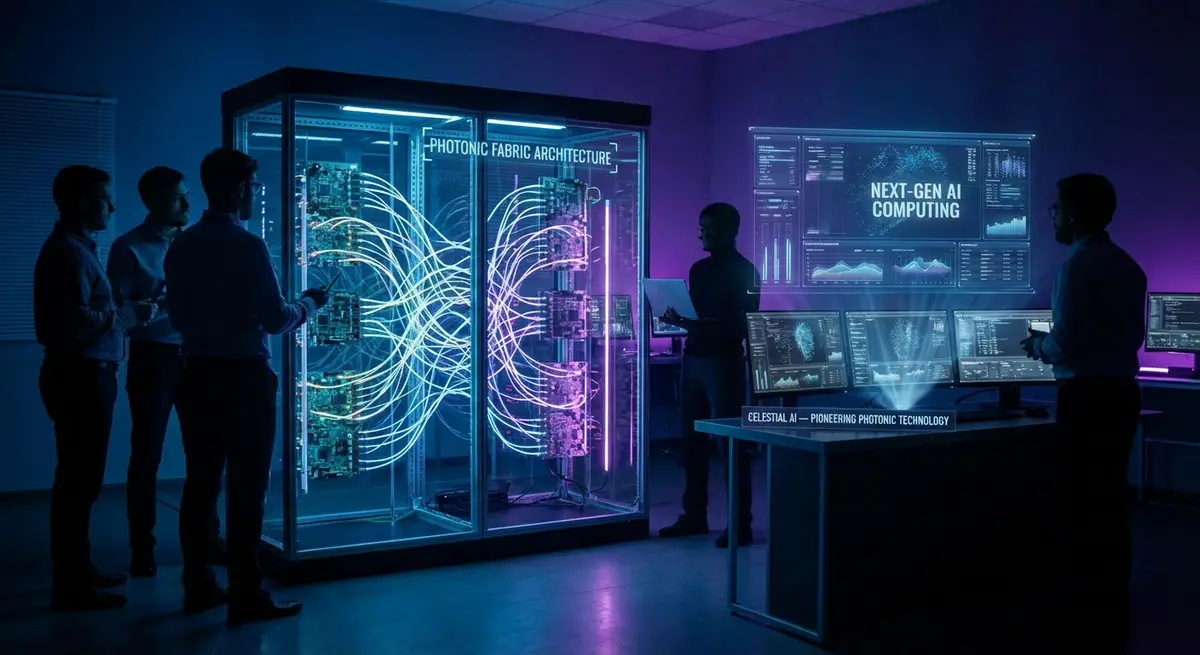
As artificial intelligence workloads continue to grow exponentially, the infrastructure supporting them faces mounting pressure. Celestial AI is addressing this challenge head-on with a fundamentally different approach to data movement, one based on photonics rather than traditional electronics. Founded to overcome the scaling limits of conventional semiconductor technology, Celestial AI uses light-based interconnects to make AI systems faster, more energy-efficient, and more cost-effective. The company has quickly become one of the most closely watched startups in AI infrastructure.
At its core, Celestial AI is tackling a bottleneck that affects every large-scale AI deployment: how to move massive amounts of data between processors quickly enough to keep up with the demands of modern machine learning. Their solution leverages photons instead of electrons, enabling data transfer at speeds and efficiencies that traditional chips struggle to match. Let's explore what makes Celestial AI's approach significant and how it could reshape the future of data center design and AI computing.
Photonic Fabric Technology
At the heart of Celestial AI's innovation is the Photonic Fabric, a cutting-edge optical interconnect platform that combines photonic and electronic components to move data in ways traditional chips cannot. Instead of relying solely on electronic signals, it uses photons for high-speed data transfer, significantly reducing power consumption and latency.
This hybrid approach delivers ultra-high bandwidth with latency measured in nanoseconds, allowing processors to communicate almost instantaneously. The platform also incorporates in-network memory and compute capabilities, enabling it to handle enormous data volumes without creating bottlenecks. What truly sets it apart is its use of optical addressability, which frees the technology from the scaling limitations imposed by Moore's Law. Celestial AI claims this approach is roughly a decade ahead of current alternatives.
For AI workloads, this means the ability to scale across thousands of processors with terabytes of bandwidth. Curious about the technical details? Explore how Celestial AI's Photonic Fabric is redefining AI infrastructure.
AI Infrastructure Challenges
Modern AI faces significant infrastructure hurdles, particularly around data movement within large-scale data centers. Traditional electronic interconnects are struggling to keep pace with the explosive growth of AI models and machine learning demands. They consume excessive power, generate heat, and introduce latency that limits system performance.
Celestial AI addresses these pain points directly. Their technology enables seamless connections between AI accelerators, making it considerably easier to build distributed systems capable of training advanced neural networks or running real-time AI applications. By using light for data transmission, the approach slashes energy consumption while dramatically increasing throughput. Research indicates this could transform high-performance computing, especially in sectors that depend on rapid, reliable data flow.
Product Suite Overview
Celestial AI offers a concrete product lineup designed to bring their photonic vision to market. Their portfolio includes PFLink, PFSwitch, and OMIB, each targeting different components of AI system architecture.
PFLink is available as a chiplet or licensable IP, providing optical links for flexible system configurations. PFSwitch is a photonic switch that connects processors with low latency and high bandwidth. OMIB handles advanced packaging, integrating the various components into a cohesive system.
These products are particularly well-suited for linking AI accelerators (XPUs) across large computing environments. They support the scaling requirements of complex reasoning models, which are increasingly important in fields like natural language processing. For more details, explore Celestial AI's product offerings to understand how they enable massive AI interconnectivity.
Company Leadership Expertise
Celestial AI benefits from a leadership team with deep expertise in semiconductor technology and photonics. Co-founders David Lazovsky and Preet Virk bring decades of relevant experience to the company.
David Lazovsky, serving as CEO, previously managed over $1 billion in business at Applied Materials. He founded Intermolecular and took it public, demonstrating his ability to scale technology companies from concept to market success.
Preet Virk, as COO, has led engineering teams at MACOM and Mindspeed Technologies. He pioneered electro-optical solutions that powered 100G data center technology, giving him direct expertise in the photonics and communications domains central to Celestial AI's mission.
CTO Phil Winterbottom brings a Bell Labs background in photonics and AI hardware. The leadership team is rounded out by specialists including Narayan Kaniyur in engineering and Kelyn Brannon as CFO, ensuring the company has both the technical depth and business acumen needed to execute its ambitious roadmap.
Funding Milestones
Celestial AI has attracted significant investor confidence. The company raised $56 million in Series A funding to develop its Photonic Fabric platform, with the explicit goal of breaking free from the constraints of traditional transistor-based scaling.
By March 2025, the company secured a $250 million round, accelerating technology development and commercial deployment. This level of investment signals strong market confidence in the photonic approach to AI infrastructure.
With an eye on a $70 billion addressable market, Celestial AI is positioning its Orion AI accelerators as essential components for next-generation AI infrastructure. For the full story on their growth trajectory, read about Celestial AI's funding rounds.
Target Markets Analysis
Celestial AI's technology is aimed at the organizations with the most demanding AI infrastructure needs. Data center operators, who need efficient ways to handle massive and growing workloads, are primary customers. AI hardware manufacturers and enterprises building high-performance computing environments also stand to benefit significantly.
Hyperscale companies running cloud services represent another key market segment, as they require the kind of scalable interconnectivity that photonic technology enables. While specific customer names have not been publicly disclosed, the company's focus is squarely on the innovators driving AI development and data center design at the largest scales.
Competitive Landscape
The optical interconnect space is growing increasingly competitive, but Celestial AI differentiates itself through breadth. While competitors like NVIDIA (with NVLink) or Broadcom offer solutions for specific parts of the interconnect challenge, Celestial AI covers the full stack, including connectivity, switching, and packaging.
This integrated approach makes their technology particularly well-suited for large AI environments where end-to-end optimization matters. Unlike companies focusing on single components, Celestial AI provides a unified solution designed to work seamlessly across the entire data path. In a market hungry for better AI networking, this comprehensive strategy gives them a meaningful competitive edge.
Strategic Vision Pillars
Celestial AI's long-term strategy rests on three core principles. First, solving real customer problems, particularly data movement bottlenecks that constrain AI training and inference workloads.
Second, designing for reliability, manufacturability, and cost-effectiveness from the outset. This ensures their technology is practical for widespread commercial deployment, not just technically impressive in the lab.
Third, building a robust ecosystem of partners spanning silicon designers, system integrators, and memory providers. These partnerships make adoption smoother and integration more straightforward. Learn more about their strategic partnerships ecosystem and how it supports AI deployment at scale.
Industry Recognition Highlights
Celestial AI has garnered notable attention from industry analysts and technology experts. Some observers have compared the potential impact of their Photonic Fabric to the transformative effect that OpenAI's GPT models had on the AI landscape.
One prominent review described the technology as "as significant" for AI computing, networking, and memory as GPT was for language models. This level of recognition from industry leaders positions Celestial AI as a company to watch closely as the AI infrastructure market continues to evolve.
Future of AI Computing
Looking ahead, Celestial AI's innovations could fundamentally reshape AI infrastructure. As machine learning models grow more complex, the demand for faster and more efficient data movement will only intensify.
Their photonic approach, decoupled from Moore's Law limitations, offers a path to sustained performance improvements even as traditional semiconductor scaling slows. This opens the door for advancements in deep learning, edge computing, and beyond. The prospect of AI systems processing data at the speed of light, powering applications from smart cities to personalized medicine, is moving closer to reality.
Photonic Advancements Impact
The broader implications of photonic technology for AI are substantial. Lower energy consumption is perhaps the most immediately relevant benefit, as data centers worldwide face growing pressure to reduce their power footprint.
For developers and system architects, photonic interconnects mean easier scaling of AI applications without requiring massive hardware overhauls. This could accelerate research and deployment in fields like computer vision and predictive analytics. Celestial AI's work highlights an industry-wide shift toward hybrid systems that blend light and electronics for optimal performance.
Market Opportunity Expansion
With a $70 billion addressable market in view, Celestial AI is positioning for significant growth. Their Orion products target the surging demand for AI accelerators, which are essential for training and running increasingly large neural networks.
Investor enthusiasm reflects this opportunity, with substantial capital flowing into photonic AI infrastructure. As artificial intelligence integrates into more industries and use cases, demand for the kind of advanced infrastructure Celestial AI provides is expected to grow dramatically. This positions the company as a key player in the next phase of AI hardware evolution.
Leadership Team Depth
Beyond the co-founders, each member of the leadership team brings specialized expertise. SVP of Engineering Narayan Kaniyur drives technical execution, while CFO Kelyn Brannon manages the company's financial strategy. VP of Sales Steven Metz leads market adoption efforts, and Ankur Aggarwal oversees packaging and supply chain operations. Subal Sahni heads photonics engineering, and Victoria Sevilla manages people operations.
This diverse team ensures Celestial AI can navigate the complex challenges of semiconductor innovation while maintaining commercial focus. Learn more about their experienced leadership team for additional insight into the company's capabilities.
Partnership Ecosystem Building
Strategic partnerships are central to Celestial AI's go-to-market strategy. The company is actively building relationships with ASIC designers, system integrators, and HBM memory providers to create a robust supply chain and smooth adoption path for their technology.
An aggressive development roadmap keeps them ahead of market needs, while tight integration with existing industry workflows reduces barriers to adoption. These collaborations foster innovation and ensure that photonic solutions fit naturally into existing AI ecosystems.
Revolutionary Potential Explored
What if AI computing infrastructure evolved as dramatically as language models have in recent years? Celestial AI's technology could be that kind of catalyst. By enabling terabyte-scale bandwidth between processors, their platform supports unprecedented AI scaling. This could drive breakthroughs in areas ranging from autonomous systems to climate modeling and scientific simulation.
The most compelling aspect is the unknown: how far can photonic technology take AI computing, and what applications will it unlock that we have not yet imagined?
Celestial AI's Bright Horizon
Celestial AI represents a significant bet on photonics as the future of AI infrastructure. With their Photonic Fabric platform, a strong product lineup, substantial funding, and experienced leadership, the company is well-positioned to address the growing gap between AI computing demands and current infrastructure capabilities.
As AI continues its rapid expansion into every sector of the economy, the companies that solve the fundamental infrastructure challenges will play an outsized role in shaping what comes next. Celestial AI is making a compelling case that photonics will be at the center of that story. For the latest updates, visit Celestial AI's official site.