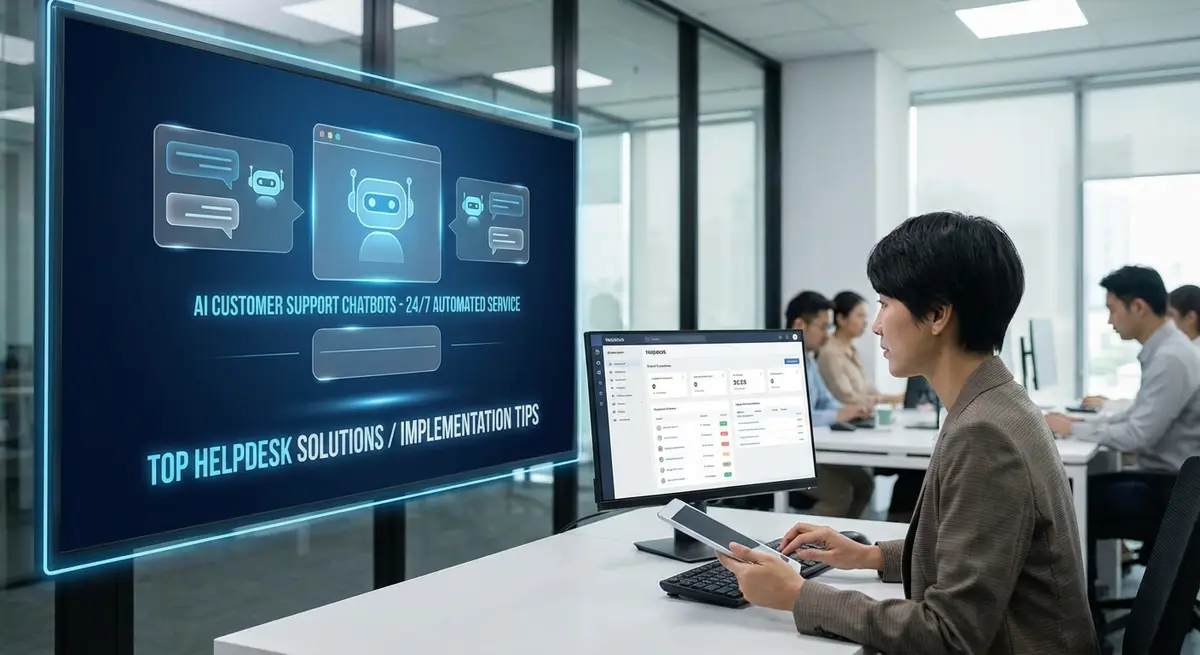
AI customer support chatbot technology is transforming how businesses handle customer interactions. These artificial intelligence-powered tools automate conversations through chat interfaces, resolving inquiries quickly and efficiently at a time when customers expect instant answers. The pressure on companies to deliver responsive service without delays has never been greater.
Many organizations are turning to AI chatbot solutions to manage high query volumes without overwhelming their human support teams. These tools automate routine tasks like answering frequently asked questions, providing order updates, and handling basic troubleshooting, freeing human agents to focus on complex issues that require empathy and judgment. As global operations expand, the need for 24/7 customer service grows alongside them. Customers across time zones expect help at any hour, and an AI chatbot provides constant availability while reducing the need to hire additional staff.
This guide covers the essential aspects of AI customer support chatbots: what they are, their benefits, key features to evaluate, leading solutions, implementation steps, real-world examples, potential challenges, and how to get started. Whether you are a small startup or a large enterprise, these insights will help you make informed decisions about automating your customer support operations.
Understanding AI Customer Support Chatbots
An AI customer support chatbot is a software application that uses artificial intelligence to simulate human conversations. It relies on machine learning and natural language processing (NLP) to understand customer questions and generate relevant responses. These bots operate across websites, mobile apps, and messaging platforms like WhatsApp and Facebook Messenger, meeting customers wherever they prefer to communicate.
In automated customer service environments, chatbots take over repetitive tasks such as answering common questions, processing returns, and guiding users through setup procedures. This reduces the volume of routine work that reaches human agents, allowing them to concentrate on more nuanced problems. A bot might resolve a password reset in seconds, for example, while an agent focuses on resolving a billing dispute that requires careful investigation.
The core technologies powering these bots include NLP, which deciphers user intent from everyday language (including slang and typos), and machine learning, which enables the bot to improve its accuracy over time by analyzing past interactions. Integration with CRM systems ensures that data flows smoothly between the chatbot and your customer records, updating information automatically with each interaction.
Multichannel support is a key capability. Chatbots work consistently across email, live chat, and social media, creating a unified experience regardless of how a customer reaches out. For global organizations, this means providing support without time limits or staffing gaps. Helpdesk chatbot solutions integrate with ticketing systems to classify inquiries, assign priorities, and escalate complex issues to human agents when needed. The 2025 AI Index Report from Stanford HAI shows AI adoption in customer service grew by 25% year-over-year, driven largely by these efficiency gains. View the AI adoption trends report for additional details.
Benefits of Implementing an AI Customer Support Chatbot
Implementing an AI customer support chatbot delivers measurable financial and operational benefits. These tools handle up to 80% of routine inquiries, reducing operational expenses by approximately 30% based on industry benchmarks. Businesses avoid the need to expand their support teams proportionally as they grow.
Faster response times represent one of the most noticeable improvements. Chatbots reply instantly, compared to the 2-5 minute average for human agents handling individual queries. This keeps customers satisfied and reduces the frustration that comes with long wait times. Scalability is equally important: during sales events, product launches, or seasonal peaks, an AI chatbot manages thousands of simultaneous conversations without any degradation in response quality.
Helpdesk chatbot solutions lighten agent workloads significantly. Bots handle straightforward tasks and route more complex issues to human agents, who can then focus on high-value interactions like resolving escalations or identifying upsell opportunities. Automated customer service streamlines internal workflows as well, with chatbots creating tickets, sending follow-up messages, and logging interactions automatically, saving time and minimizing manual errors.
Personalization improves the customer experience further. AI analyzes user data to deliver tailored responses, such as suggesting relevant products based on purchase history or proactively addressing known issues. Customers feel recognized and valued, which builds long-term loyalty. ROI typically materializes within 6-12 months through a combination of efficiency gains and incremental sales. Forrester forecasts that 70% of customer service interactions will be AI-driven by 2026, with corresponding increases in satisfaction scores. Check the Forrester AI predictions report for additional insights.
Constant availability through 24/7 support ensures no queries are missed outside business hours, which is particularly valuable for businesses serving international audiences across multiple time zones.
Key Features to Look for in the Best Chatbots for Support
When evaluating the best chatbots for support, several features should guide your decision.
AI-driven personalization uses customer data to customize replies, such as recommending products from purchase history or addressing returning customers by name. This makes interactions feel individual rather than generic. Multi-channel support is essential, with top bots working consistently across web, mobile apps, and social media so users can switch devices without losing context.
Analytics and reporting tools track performance metrics including resolution rates, chat durations, and satisfaction scores, providing the data needed to continuously optimize the bot's effectiveness. Integration capabilities matter significantly as well. The best chatbots connect with CRM, e-commerce, and inventory systems to pull real-time data during conversations, enabling accurate and helpful responses.
Ease of use is important for ongoing management. Look for platforms with drag-and-drop builders that enable quick setup and modification without requiring developer resources. Customization options should allow you to align the bot's tone and behavior with your brand voice. Security features, including encryption and compliance with regulations like GDPR, ensure sensitive customer information is handled responsibly.
Advanced NLP is what separates effective chatbots from basic rule-based systems. Superior bots understand context, handle nuanced questions, and improve their accuracy over time through machine learning. Sentiment analysis detects customer frustration and triggers escalation to a human agent when the situation calls for it.
The Microsoft Global AI Adoption report notes that 60% of businesses prioritize tools with strong integration capabilities. Explore the global AI adoption insights for more on this trend. When choosing, consider your business size: smaller firms typically need affordable, straightforward options, while enterprises require robust scalability and advanced customization.
Top AI Customer Support Chatbot Solutions
Finding the right chatbot involves reviewing platforms that offer robust features suited to your business size and industry. The leading AI customer support chatbot platforms feature advanced NLP that handles complex queries and learns from data over time.
- Pros: Quick setup and high accuracy for most use cases.
- Cons: May require initial training with your specific data for optimal results.
Pricing typically starts around $50/month for basic plans and scales to enterprise tiers, with subscription models that often include usage-based components to keep costs aligned with actual volume.
Use cases vary by industry. In e-commerce, bots track orders and suggest alternatives when items are unavailable. For technology companies, they troubleshoot software issues around the clock. Helpdesk chatbot solutions integrate with ticketing systems to route queries efficiently and reduce agent burnout. Across all industries, 24/7 availability ensures instant support regardless of time zone.
Key comparison criteria include:
- NLP Strength: Advanced bots score high for natural, context-aware conversations.
- CRM Compatibility: Top options link seamlessly with major platforms like Salesforce and HubSpot.
- Entry-Level Pricing: Affordable options exist for startups, many with free trial periods.
- Query Volume Capacity: Leading solutions handle thousands of daily conversations without performance issues.
McKinsey's report on agentic commerce discusses how AI agents are transforming customer interactions, with efficiency gains of up to 40%. See the McKinsey agentic commerce analysis for details.
Multichannel support options provide broad reach across platforms, though premium features may carry higher costs. In hospitality, these bots manage bookings and FAQs effectively. For small businesses, open-source and customizable options emphasize workflow automation. Enterprise-grade solutions include analytics dashboards that track ROI through metrics like cost per resolution and customer satisfaction trends.
Select your solution based on your specific needs. For tailored implementations that integrate with your existing systems, theautomators.ai can help configure the right solution for your environment.
How to Choose and Implement an AI Customer Support Chatbot
Choosing an AI customer support chatbot starts with a clear assessment of your needs. Review your inquiry volumes and the types of questions your team handles most frequently. If FAQ traffic dominates your support queue, prioritize bots with strong NLP capabilities.
Step 2: Evaluate your options. Focus on features like third-party integrations, scalability, and ease of management. Compare the best automation tools for SMB using demos and trial periods to see how each platform performs with your actual use cases.
Step 3: Test usability. Run pilot programs to verify response accuracy, interface quality, and the overall user experience from the customer's perspective.
Step 4: Implement by connecting the chatbot to your existing systems using APIs. Train the AI with your historical support data to improve relevance and accuracy from day one.
Throughout the process, ensure data privacy compliance with applicable regulations like CCPA and GDPR. For integration challenges, select platforms that are compatible with your existing helpdesk and CRM tools. If AI accuracy is a concern, establish continuous training and feedback loops that allow the bot to improve based on real interactions.
For the smoothest rollout, start small. Pilot the chatbot on a single channel, measure results, refine responses based on real user feedback, and then expand to additional channels once performance is validated.
Case Studies and Real-World Examples
A major retailer adopted an AI customer support chatbot and cut response times by 50%. Customers received instant help with order inquiries, and retention improved by 20%, demonstrating the impact of automated customer service at scale.
In the technology sector, a company deployed 24/7 AI support for its global customer base. The system handled inquiries across time zones, reducing support costs by 25% while improving resolution rates by 30%.
An e-commerce business integrated a helpdesk chatbot solution to manage product returns. Bots handled the routine return process, freeing agents to focus on sales-oriented interactions. Customer satisfaction scores improved by 15% based on internal tracking.
These results align with trends documented in Stanford and Forrester reports, confirming that AI-driven customer support delivers measurable improvements in efficiency, cost management, and customer satisfaction.
Potential Challenges and Solutions
Initial setup costs can be a concern, but scalable pricing plans let you start small and grow your investment as you see results. Choose platforms that offer entry-level tiers with room to expand.
Handling emotional or sensitive customer interactions is a genuine limitation of current AI. Hybrid models that escalate complex or emotionally charged conversations to human agents address this effectively, combining the efficiency of automation with the empathy that certain situations require.
For ongoing optimization, follow best practices like scheduling regular updates, monitoring performance metrics, and incorporating user feedback into the bot's training data. This creates a continuous improvement cycle that keeps the chatbot performing well as your business and customer needs evolve.
An AI customer support chatbot transforms how businesses deliver customer service, providing 24/7 availability, significant cost savings, scalability during peak periods, and better customer experiences. These tools represent one of the most practical and high-ROI applications of AI for businesses of any size.
Key takeaways include measurable cost reductions, improved response times, and the ability to scale support operations without proportional increases in headcount. Ready to enhance your customer support? Explore chatbot options, run demos, and evaluate which solution fits your needs. For customized implementation support, contact theautomators.ai, where the team specializes in deploying AI solutions tailored to your specific business requirements.