
TL;DR
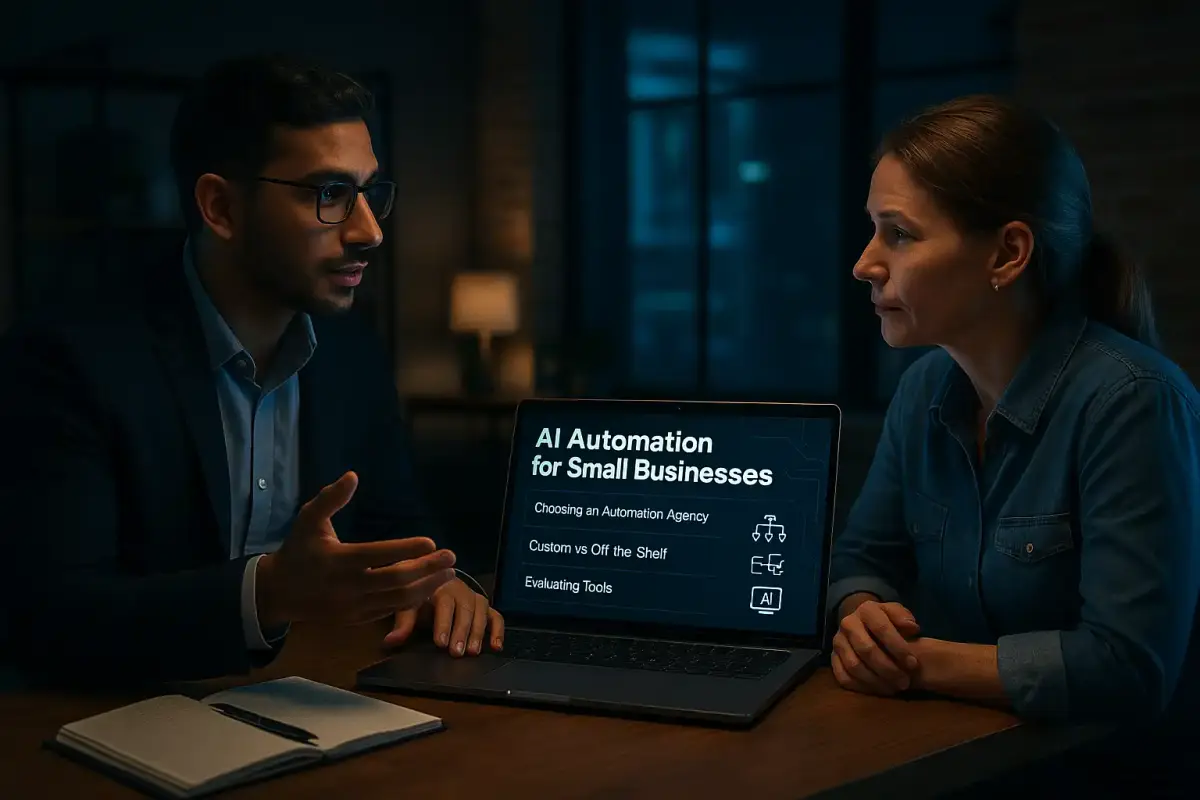
AI automation for small business works best when you choose one measurable workflow, fix its process and data problems, then match it with the right provider. This guide compares platforms, RPA vendors and agencies, explains 2026 pricing, and provides a practical scorecard for selecting a partner.
How Do You Choose AI Automation for Small Business?
Choose based on the workflow, your technical capacity and who will maintain the system. Use a platform for simple tasks, an RPA provider for legacy software, or an agency for integrated workflows that cross several systems.
Access to AI is no longer the main barrier. The challenge is turning isolated tools into dependable business processes. Research highlighted by the OECD-ICSB Forum noted that small-firm AI adoption rose from 7 percent to 17.5 percent between 2023 and 2025.
The report emphasized that adoption differs from operational capability. Most small firms access basic tools without reaching the strategic, integrated uses that drive productivity.
That gap matters when comparing providers. Buying a chatbot that drafts replies differs from buying an agent that checks a CRM, applies business rules and updates an order.
The best AI automation for small business connects technology to a specific operational result. That result could be faster lead response, fewer invoice errors or more capacity for customer work.
We start by identifying the bottleneck and its current cost. Tool selection comes later because the cheapest subscription becomes expensive when staff must supervise it.
What Can a Small Business Automate With AI?
Start with repetitive, high-volume tasks that follow a recognizable pattern. Keep people responsible for exceptions, sensitive decisions and work that depends on trust or complex judgment.
Traditional automation follows predefined rules. AI adds value when the input is less structured, such as an email, conversation, scanned document or open-ended customer request.
| Workflow | Automation handles | AI contributes |
|---|---|---|
| Lead management | CRM entry, routing and follow-up | Classifies enquiries and drafts relevant replies |
| Bookkeeping | Record updates and reconciliation steps | Extracts invoice data and flags unusual entries |
| Scheduling | Bookings, reminders and rescheduling | Understands requests written in natural language |
| Customer support | Ticket creation, routing and status updates | Retrieves knowledge and suggests answers |
| Reporting | Data collection and report delivery | Summarizes changes, risks and required actions |
AI can also help staff produce more consistent output across routine tasks. As an analysis in MIT Technology Review notes, productivity advances rely on innovation that helps workers deliver more services on average, even if broad economic gains take time to appear.
This is an augmentation model: the system retrieves guidance while the employee handles context, judgment and the customer relationship.
In our projects, we separate routine decisions from exceptions before building. This prevents the automation from making choices that should remain with an employee or owner.
The Three Types of AI Automation Companies
The phrase “AI automation company” covers three different purchases. Each category has a different cost structure, maintenance burden and level of customization.
1. No-code and low-code platforms
Platforms such as Zapier, Make and n8n connect common business applications through visual workflows. They can also add generative AI for classification, summarization and content generation.
These tools suit standard processes with clear triggers and actions. Someone inside the business must still test, monitor and repair the workflows.
2. RPA and enterprise platforms
Robotic process automation, or RPA, uses software robots to perform structured tasks through existing interfaces. It is useful when older software lacks an application programming interface, commonly called an API.
RPA platforms offer stronger governance and orchestration. They usually require more specialist support, making them better suited to high-volume or compliance-heavy operations.
3. Agencies and consultants
An automation agency maps the process, selects tools and builds the integrations. It may also develop custom AI agents, train staff and provide ongoing monitoring.
This model fits businesses that want an operational result rather than another platform to learn. It also works well when a workflow crosses email, accounting, scheduling, CRM and internal databases.
| Provider | What you buy | Maintenance owner |
|---|---|---|
| No-code platform | Software and connectors | Your business |
| RPA platform | Robots, orchestration and governance | Internal IT or a specialist |
| Agency | A designed and implemented workflow | Agency or trained client staff |
Freelancers sit between platforms and agencies. They can be a good fit for a defined workflow, but ownership and post-launch support must be clear.
How Can I Automate My Business Using AI?
Pick one valuable process, document how it works today and establish a baseline. Then improve the process, automate a controlled version and expand only after the results are stable.
- Choose the bottleneck. Look for recurring work that causes delays, errors or lost opportunities.
- Measure the baseline. Record staff time, turnaround time, error frequency and unfinished work.
- Map every step. Include spreadsheets, duplicate entry, manual approvals and unofficial workarounds.
- Remove unnecessary work. A bad process becomes a faster bad process when automated unchanged.
- Check the systems. Identify where data lives, who can access it and whether the software supports integrations.
- Define human oversight. Decide which actions run automatically and which require approval.
- Test real exceptions. Use incomplete forms, unusual requests and conflicting information, not only ideal examples.
- Monitor the outcome. Compare performance with the original baseline and investigate failures.
We prefer a narrow first release with a clear owner. It is easier to test, easier to explain to employees and easier to roll back if the process changes.
A useful first project should also be repeatable. Automating a task performed occasionally may save minutes, while improving daily lead intake can affect sales capacity and customer response.
Begin with a workflow whose inputs, decisions and desired output can be described plainly, rather than trying to automate an entire department.
How to Vet an AI Automation Company
A credible provider should understand your workflow before recommending software. It should also explain data handling, ownership, testing, maintenance and how success will be measured.
| Criterion | Good answer | Red flag |
|---|---|---|
| Discovery | Asks about volume, errors and business impact | Quotes before understanding the process |
| Scope | Defines deliverables, exclusions and acceptance tests | Uses vague promises about transformation |
| Tool choice | Explains why each component is needed | Uses the same stack for every client |
| AI controls | Sets approval rules and fallback behaviour | Treats model output as automatically correct |
| Security | Documents access, storage and permissions | Cannot explain where sensitive data goes |
| Ownership | Clarifies accounts, workflows and documentation | Locks the build inside provider accounts |
| Support | Defines monitoring and issue resolution | Has no plan for software changes |
Ask the provider to demonstrate a comparable workflow. A useful demonstration shows inputs, decisions, system actions, error handling and audit records. A polished chatbot alone proves very little.
Ask what happens when confidence is low. Reliable systems pause, request more information or route work to a person instead of guessing.
We document the workflows and accounts we deliver so clients can understand what they own. We also define maintenance responsibilities before launch, rather than after a failure.
What Does AI Automation Cost in 2026?
Small-business implementations commonly cost $2,500 to $15,000 upfront, with ongoing costs of $500 to $5,000 per month. Complexity, transaction volume, custom development, support and security requirements determine where a project falls within those ranges.
Basic workflows may use existing software and standard connectors. Costs rise when a project needs custom APIs, legacy-system access, several data sources or agentic decision-making.
| Cost category | What it covers |
|---|---|
| Discovery | Process mapping, requirements and ROI baseline |
| Implementation | Workflow design, integrations, testing and deployment |
| Software | Automation plans, connectors and model usage |
| Support | Monitoring, repairs, optimization and training |
One industry pricing analysis places broader project-based consulting between $5,000 and $50,000. Ongoing partnerships can range from $2,000 to $25,000 per month, although the upper end usually reflects wider transformation work.
Calculate value from the process rather than the software price. Add the annual cost of staff time, corrections, delays and missed work. Then estimate what the automation can remove or improve.
Revenue claims require the same discipline. While AI cannot guarantee $10,000 per month or $1,000 per day, it can support those goals by increasing capacity, improving conversion or making a new service economical.
A provider promising income without examining demand, margins and operational limits is selling speculation rather than automation.
Which Jobs Will Survive AI in a Small Business?
AI is more likely to change groups of tasks than erase every role with a particular title. Work involving relationships, complex judgment, creativity and skilled physical activity remains more resistant to full automation.
Routine administrative tasks face greater exposure. These include data entry, template-based communication, simple scheduling and repetitive document processing. Employees can shift toward exception handling, customer relationships and quality control.
A Bank of America report found that only 1% of small and mid-sized business owners plan layoffs in the next 12 months, while 43% plan to hire more. Rather than replacing workers wholesale, businesses are deploying automation to relieve staffing pressure.
For an owner, the practical question is which tasks need empathy, accountability, local knowledge or judgment. Those tasks should remain human-led.
Responsible implementation also requires transparency. Tell employees what the system will do, what it will not do and how their responsibilities will change.
Training should cover more than prompting. Staff need to recognize poor output, protect sensitive information and escalate unusual cases. They should also know how to continue working if an automated service is unavailable.
We involve the people who perform the process because they know its exceptions. Their input usually exposes risks that are invisible in a high-level workflow diagram.
Where We Fit and When Another Option Is Better
We build done-for-you workflow automation and custom AI agents for businesses in Canada and the United States. Our work covers process mapping, integrations, business logic, testing, documentation and handover.
We are a strong fit when work crosses several systems or depends on custom rules. We also help when a business has outgrown isolated automations and needs a more reliable architecture.
We are not the right option for every project. A standard no-code feature may be enough for a simple notification or data transfer. RPA may be more suitable when a high-volume process depends on legacy desktop software.
Our approach is to recommend the least complex system that can deliver the required result. Adding an AI agent where fixed rules would work creates more cost, more testing and more ways to fail.
Before speaking with any provider, bring one process and its current numbers. Include the systems involved, the people responsible and the exceptions that cause trouble.
A useful first conversation should tell you which provider category fits, what must be fixed before implementation and how success will be measured. If those answers remain unclear, the project is not ready for a proposal.
The goal is to build a dependable process that saves time, reduces errors or creates useful capacity, while keeping people responsible for the decisions that matter.