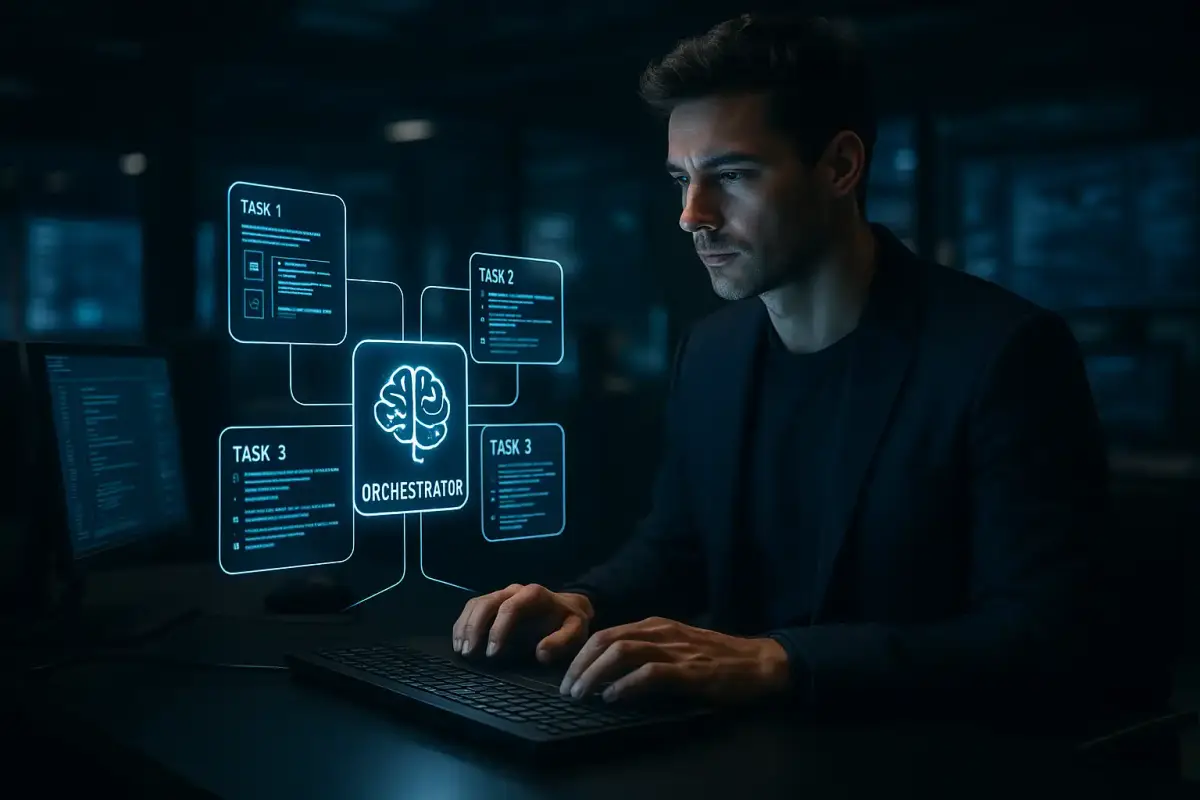
Complex AI systems often need to manage multiple tasks simultaneously, and keeping everything running smoothly requires careful coordination. This is where the orchestrator agent comes in. An orchestrator agent serves as the central coordinator in a multi-agent AI system, directing specialized agents, managing workflows, and ensuring that complex processes execute reliably from start to finish.
Think of an orchestra where each musician plays a different instrument. Without a conductor, the result would be noise rather than music. The orchestrator agent fills that conductor role for AI systems, coordinating multiple agents to produce coherent, efficient outcomes. As AI grows more advanced, understanding this coordination layer is essential for building systems that work reliably in production environments.
Task Coordination in AI Workflows
At its core, the orchestrator agent's purpose centers on task coordination. When a high-level request comes in (for example, "Handle this customer support query"), the orchestrator doesn't simply pass it along. It decomposes the request into smaller, manageable subtasks, assigns each to the specialist agent best suited for the job, and tracks progress in real time.
This coordination ensures that handoffs between agents happen smoothly and without bottlenecks. If one agent analyzes data while another generates reports, the orchestrator oversees the transitions and validates outputs at each stage. According to IBM's guide on AI agent orchestration, this decomposition and assignment process turns broad user requests into structured, executable action plans.
The real-time tracking capability is particularly valuable. The orchestrator monitors each step and adjusts course if something goes off track, making the overall system feel responsive and reliable rather than brittle. For a deeper look at how planning functions integrate into agentic systems, see our exploration of the primary function of a planner agent within agentic AI systems.
Automation and Adaptation for Dynamic Processes
Beyond simple coordination, orchestrator agents excel at automation and adaptation. Unlike basic AI tools that handle one-off tasks, orchestrators run continuously within larger processes and adapt on the fly, responding to changes in context or new data as they arise.
In a long-running workflow, the orchestrator might suggest alternative approaches or make autonomous decisions when obstacles appear. Research from Flowable's deep dive into AI orchestrator agents highlights how they integrate into process models, offering dynamic suggestions that keep workflows moving forward even when conditions change.
This adaptability is what separates orchestrated AI systems from rigid, script-based automation. For businesses dealing with shifting demands, an orchestrator agent acts as a flexible manager that anticipates needs and adjusts plans accordingly. If you're new to implementing such systems, our beginner's guide on how to start automating your business provides practical steps to get started.
Maintaining Workflow Integrity Across Agents
One of the orchestrator agent's most critical functions is maintaining workflow integrity. It manages dependencies, timing, and data flows between multiple agents, ensuring each one completes its part at the right moment and passes outputs seamlessly to the next step in the process.
When Agent A finishes analyzing data, the orchestrator hands the results to Agent B for visualization, all while verifying that outputs align with expected formats and quality standards. As explained in Wikipedia's overview of multi-agent systems, this dependency management prevents errors and keeps the entire process coherent.
This integrity is especially important in environments where precision matters, such as healthcare, finance, or legal services. Knowing that workflows stay intact and that data flows correctly between agents builds confidence in the system and reduces operational risk. To see how these principles apply when building robust agents, explore our practical guide to the principles of building AI agents book.
Auditability, Control, and Oversight in AI Systems
Auditability stands out as a key purpose of orchestrator agents, especially in enterprise environments. These agents maintain detailed logs of every action and outcome, creating a transparent record that supports reviews, debugging, and compliance verification. This logging also prevents rogue behavior from individual agents by enforcing business rules at the orchestration layer.
If something goes wrong, teams can trace back through the logs to understand exactly what happened and why. IBM's guide emphasizes how this control mechanism safeguards enterprise AI deployments, making them safer and more transparent for widespread organizational use.
With growing concerns about AI accountability, orchestrators provide the oversight framework needed to deploy multi-agent systems responsibly. This auditability transforms what could be an opaque black box into a traceable, governed process.
Resilience and Robustness for Reliable Operations
In the face of disruptions, resilience is one of the most important capabilities orchestrator agents provide. They handle failures, interruptions, and recovery processes in large-scale systems, keeping operations running even when individual components encounter problems.
For long-lived processes, this means the orchestrator can quickly adapt to errors by rerouting tasks if an agent fails, retrying operations with different parameters, or escalating issues for human review. Stanford's research on resilient multi-agent systems details how these agents facilitate continuity, making AI systems robust even under stress.
This resilience is what enables AI systems to operate reliably in real-world conditions, where server outages, unexpected data formats, and shifting requirements are the norm rather than the exception. For small businesses looking to implement resilient workflows, our comparison of the best workflow automation software for SMB can help you choose the right tools.
Real-World Use Cases of Orchestrator Agents
To see orchestrator agents in action, consider an enterprise IT scenario. A user asks an AI system to "Analyze these logs, report breaches, and fix issues." The orchestrator plans the steps: one agent reads the logs, another analyzes them for security threats, and a third applies patches. The orchestrator monitors progress throughout and synthesizes results into a complete response.
This kind of seamless delegation, as described in Microsoft Research's work on multi-agent systems, transforms complex requests into efficient, coordinated outcomes. It frees human IT professionals to focus on strategic decisions rather than routine analysis.
Another practical example is customer onboarding in banking, where multiple agents handle document verification, credit reviews, agreement generation, and welcome communications. The orchestrator sequences these tasks, manages dependencies between them, and ensures a smooth end-to-end experience. McKinsey's research on AI agents illustrates how this approach reduces errors and accelerates processing times.
These use cases highlight the orchestrator's role in bridging individual AI capabilities into cohesive, production-ready workflows applicable across industries like retail, logistics, healthcare, and financial services. Businesses can further enhance such implementations by exploring the top AI tools for small businesses to boost efficiency.
Technical Principles Behind Orchestrator Agents
Under the hood, orchestrator agents follow several key technical principles. They are model-agnostic, meaning they can pair different AI models with specific roles for optimal efficiency. This flexibility allows mixing advanced language models with lighter, faster ones depending on the task requirements.
Orchestrators often operate within process engines, such as CMMN case models, becoming a native part of the system rather than an external add-on. Flowable's documentation explains how this deep integration treats orchestration as a core execution capability rather than a bolted-on layer.
Modularity is another foundational principle. Orchestrator logic is designed to be scalable and easy to debug or enhance over time. As noted in IBM's guide to AI orchestration, this modular design supports evolving operations, making it straightforward to integrate new agents, update workflows, or adjust business rules as requirements change.
These technical principles enable teams to build AI systems that scale gracefully. Each component fits together in a well-defined way, and changes to one part of the system don't cascade unpredictably through the rest.
Importance of Orchestrator Agents in Modern AI
Orchestrator agents matter because they enable complex workflows that isolated agents simply cannot handle. By coordinating multi-step processes across teams of specialized agents, they unlock capabilities that would be impossible with single-agent architectures.
They support reliability by managing long-running tasks and recovering from disruptions, as detailed in research on the orchestration of multi-agent systems. This keeps AI systems responsive in dynamic, real-world environments where conditions change constantly.
Scalability and oversight are equally critical. For enterprises, orchestrators provide the governance and control needed for safe, auditable deployment at scale. Google Cloud's comprehensive overview underscores how this leads to efficient, trustworthy AI systems that organizations can rely on for mission-critical operations.
In essence, orchestrator agents optimize collaboration between AI components, ensuring efficiency, integrity, and resilience. They are a foundational layer for any organization building sophisticated multi-agent systems. To understand the broader implications for workplaces, read about how employees should think about an AI agent-enhanced workplace.
Wrapping Up the Role of Orchestrator Agents
The purpose of an orchestrator agent is to intelligently manage and direct multiple AI agents, turning what would otherwise be chaotic parallel processes into coherent, efficient workflows. From task coordination and adaptive automation to workflow integrity, auditability, and resilience, orchestrator agents address the full spectrum of challenges that arise in multi-agent systems.
As AI systems grow in complexity and capability, the orchestration layer will only become more important. Whether in banking, IT operations, customer service, or logistics, orchestrator agents provide the coordination needed to deliver reliable, scalable, and transparent AI-driven outcomes.