
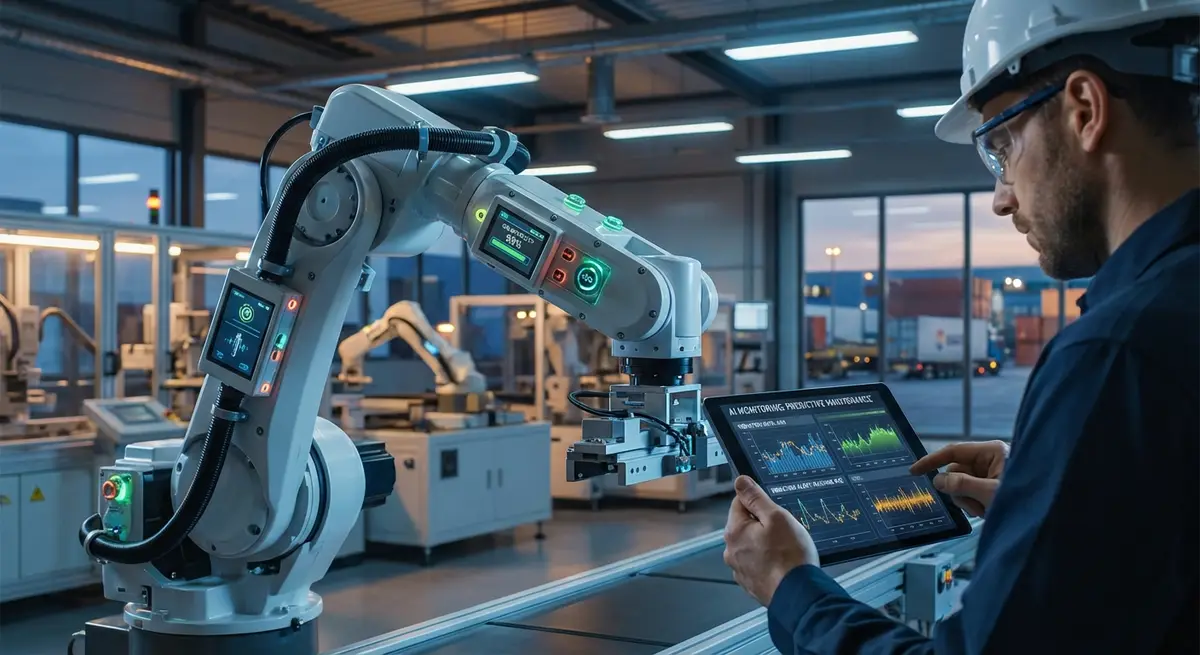
Predictive maintenance IoT uses Internet of Things sensors and data analytics to forecast equipment failures before they occur, preventing costly unplanned downtime in manufacturing environments. Operations managers who rely on reactive or scheduled maintenance face significantly higher costs, with 70-75% more unplanned downtime and 25-30% higher maintenance expenses compared to facilities using predictive approaches. By combining IoT sensor networks with AI-driven analytics, organizations can shift from fixing problems after they happen to preventing them entirely. This guide covers the foundational concepts, AI's role in maintenance prediction, industrial implementation strategies, proven benefits, step-by-step adoption guidance, and emerging trends shaping the future of equipment reliability.
Understanding Predictive Maintenance IoT
Predictive maintenance IoT combines distributed sensor networks, real-time data collection, and advanced analytics to forecast equipment issues before they result in failures. The system continuously analyzes data streams including vibration patterns, temperature readings, pressure levels, acoustic emissions, and electrical characteristics, building a comprehensive picture of equipment health that enables proactive intervention.
The architecture starts with sensors that create detailed digital fingerprints of equipment behavior. Accelerometers track vibration signatures that reveal early signs of bearing wear or misalignment. Thermocouples monitor temperature to detect overheating conditions. Pressure transducers watch fluid systems for developing leaks. Acoustic sensors analyze sound patterns to identify anomalies invisible to other measurement methods. Together, these instruments provide continuous, granular visibility into machine condition.
Connectivity layers use wireless protocols to transmit sensor data to cloud platforms, ensuring reliable data flow even in challenging manufacturing environments. Data aggregation and preprocessing clean noise from raw signals and normalize measurements across different units and scales. Machine learning models then analyze these cleaned data streams, recognizing patterns that indicate developing problems weeks or even months before a failure would occur.
The real-time monitoring capability is what distinguishes predictive maintenance from traditional approaches. Intelligent algorithms detect subtle anomalies that fall well below catastrophic thresholds, giving maintenance teams time to plan and execute repairs during scheduled windows rather than scrambling after unexpected breakdowns. Research consistently shows that predictive maintenance IoT reduces maintenance costs by 25-30% and cuts downtime by 70-75%. For deeper technical detail, explore AI equipment health monitoring.
The Role of AI and Machine Learning in Maintenance
Machine learning for maintenance analyzes both historical records and real-time sensor data to predict failures with increasing accuracy. These algorithms identify subtle patterns in sensor inputs that human analysts would miss, enabling precise forecasts of when and how equipment is likely to fail.
Several machine learning approaches serve different aspects of maintenance prediction. Supervised learning uses labeled historical data for regression tasks (estimating remaining useful life) and classification tasks (categorizing degradation states). Unsupervised learning handles situations where failure data is scarce, using anomaly detection to flag deviations from normal operating patterns. Deep learning approaches, including convolutional and recurrent neural networks, process complex time-series data without requiring manual feature engineering, making them particularly effective for vibration and acoustic analysis.
Data preprocessing and feature engineering are critical to model performance. For bearing failures, vibration data processed through frequency domain analysis can detect developing issues weeks before they become critical. Temperature trend analysis signals imminent problems in thermal systems. These preprocessing steps directly impact prediction quality, and models improve continuously through feedback loops that incorporate maintenance outcomes back into the training data.
In practice, machine learning models achieve 75-85% accuracy in their initial deployment, improving to 90-95% after 6-12 months of operation as they accumulate site-specific data. Remaining useful life prediction enables just-in-time maintenance scheduling, where repairs happen close enough to the predicted failure point to maximize component life without risking unplanned downtime.
Industrial IoT Solutions for Predictive Maintenance
Industrial IoT solutions integrate sensors, legacy equipment interfaces, cloud infrastructure, and operational workflows into facility-wide monitoring systems. These platforms scale to cover entire assembly lines and production facilities, providing the comprehensive visibility needed for effective predictive maintenance in manufacturing.
Modular deployment designs allow organizations to start with their most critical assets (typically high-utilization machinery with the highest downtime costs) and expand coverage as the system proves its value. Integration with Computerized Maintenance Management Systems (CMMS) automates work order generation when predictive models flag developing issues, while ERP connections support scheduling and resource planning for upcoming maintenance activities.
The results are significant. Facilities implementing industrial IoT for predictive maintenance report 35-45% improvements in asset utilization and up to 20% increases in capacity utilization. For further technical details, see prediction tech features. Scalability planning and economic justification are essential elements of any successful deployment, ensuring that sensor coverage expands in alignment with demonstrated ROI.
Benefits and Case Studies
The benefits of predictive maintenance IoT are well-documented across multiple metrics: 25-30% maintenance cost savings, 70-75% reduction in unplanned downtime, 35-45% improvement in asset utilization, 50-60% reduction in spare parts inventory, 20-30% extension in equipment lifespan, and 20% fewer safety incidents. Beyond these direct savings, organizations avoid cascading costs including overtime labor, production penalties, and capital expenditure delays.
Real-world implementations confirm these figures. An e-commerce logistics company achieved a 40.92% reduction in downtime and $15.2M in savings, realizing 143% ROI within 8.4 months. A lubricant manufacturing facility gained 20% utilization improvement and $12M in additional profitability through predictive maintenance deployment. These cases demonstrate that the technology delivers measurable returns across different manufacturing contexts. Additional research on safety and economic impact is available through the equipment prediction tech resource.
Implementation Guide
Adopting predictive maintenance IoT requires a structured, phased approach that builds confidence and ROI incrementally.
Phase 1: Assess and Define. Evaluate current maintenance practices and their costs. Identify and prioritize critical assets based on downtime impact and failure frequency. Establish clear objectives with measurable targets such as specific downtime reduction percentages or cost savings goals.
Phase 2: Select and Install Sensors. Choose appropriate sensor types for each asset: accelerometers for vibration monitoring, thermocouples for temperature tracking, pressure transducers for fluid systems. Ensure secure mounting and reliable connectivity, paying particular attention to harsh industrial environments where sensor durability is critical.
Phase 3: Collect Baseline Data. Gather several weeks of normal operating data across all monitored assets. Preprocess this data for quality, normalizing measurements and filtering noise to establish reliable baselines against which anomalies will be detected.
Phase 4: Develop and Tune Models. Build machine learning models trained on baseline data. Optimize detection thresholds to minimize false positives (which erode trust in the system) while catching genuine developing failures. Validate model performance against known maintenance events.
Phase 5: Integrate and Improve. Connect predictive models with CMMS and ERP systems for automated work order generation and scheduling. Train maintenance teams on interpreting alerts and responding effectively. Establish a continuous improvement cycle where maintenance outcomes feed back into model refinement.
Future Trends and Best Practices
The predictive maintenance landscape continues to evolve. Edge computing is enabling real-time responses at the sensor level, including millisecond equipment shutdowns when dangerous conditions are detected. Digital twin technology allows organizations to simulate failure scenarios virtually, testing maintenance strategies without risking production equipment.
Best practices for sustained success include establishing cross-functional governance that brings together maintenance, operations, and IT teams. Regular training ensures that staff stay current with system capabilities. Data governance policies should address both quality standards and security requirements, keeping sensitive operational data protected while ensuring models have access to the information they need. Organizations that treat predictive maintenance as an ongoing program rather than a one-time installation consistently achieve better long-term results.
Predictive maintenance IoT, powered by AI-driven analytics and industrial sensor networks, transforms maintenance from a reactive cost center into a strategic capability that prevents failures, reduces costs, and extends equipment life. The technology is proven, the ROI is documented, and the implementation path is well-established for organizations ready to make the shift.
For organizations looking to implement predictive maintenance solutions, The Automators provides expert guidance on designing and deploying IoT-based monitoring systems tailored to your specific manufacturing environment.